

ChatGPT has long been everyday reality for many teams — often unofficially, around the company rather than through it. That's understandable: the tool is impressive. But there's a big difference between "employees privately use ChatGPT" and "the company uses AI". Here's the honest classification.
What ChatGPT & co. are great at in a company
The public AI services are excellent for work without sensitive data: drafting and revising texts, structuring ideas, summarizing research, explaining code snippets, preparing translations. Teams that use them for this work measurably faster — that's not a fad, it's the new normal.
The mistake isn't using them. The mistake is stopping there.
The three limits every company runs into
1. Data protection. The moment customer data, prices, contracts or internal documents wander into a public chat window, they leave your building. For GDPR-relevant data you need at least the business tiers with a data processing agreement — and even then the question remains whether that data should see a third-party data center at all. An internal policy ("what may go in, what may not") is the minimum; most companies don't have one.
2. Reliability. ChatGPT doesn't know your products, prices or processes — it guesses based on world knowledge. For a text draft, that's fine. For a customer reply, a quote or a delivery-time statement, guessing is a business risk.
3. Repeatability. A chat window is manual labor: every case needs a human who asks, checks and copies. The real lever of AI — routine workflows running by themselves — stays unused.
The step beyond the chat window
The companies that genuinely profit from AI go one step further — in one of two directions, often both:
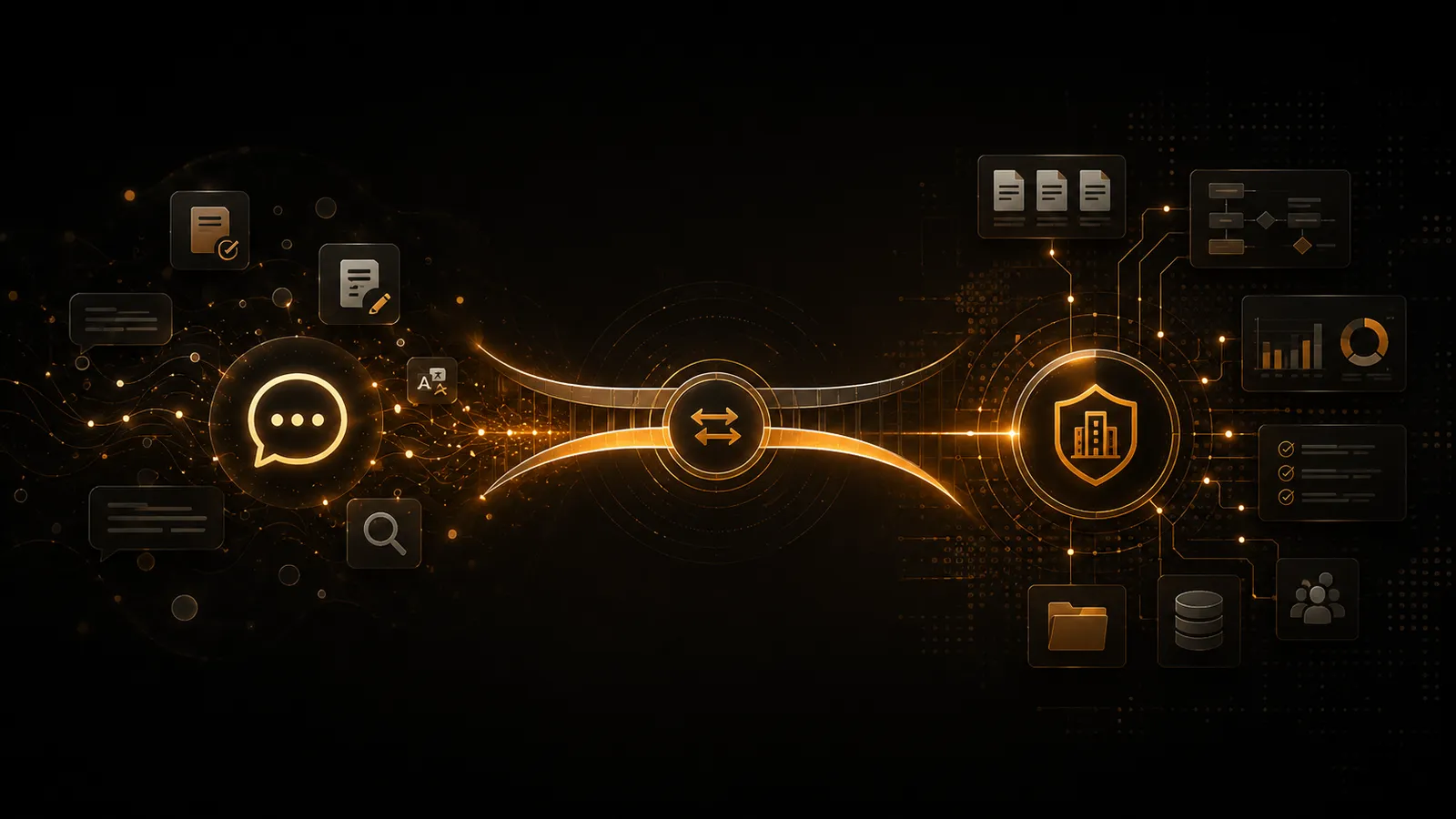
AI with your knowledge. An assistant built on your products, documents and tone doesn't answer with world knowledge but with your knowledge — and can run where your data lives. For sensitive data this is often the only clean path; small specialized models (SLMs) also make it economically attractive.
AI inside your workflows. Instead of a human copying every case into a chat window, the AI sits directly in the workflow: reads the request, pulls the data, creates the document, posts the case. That's the difference between "typing faster" and "not typing at all".
Starting pragmatically
Our advice is unspectacular: use the public tools for everything non-critical — with a clear, short policy. And in parallel, identify the two or three workflows where your own knowledge, data protection or volume demand more than a chat window. That's where the real edge is built.
What the path to your own model looks like — from feasibility check to operation under your control — is shown at Custom AI models. Or tell us directly where ChatGPT hits its limits for you today.